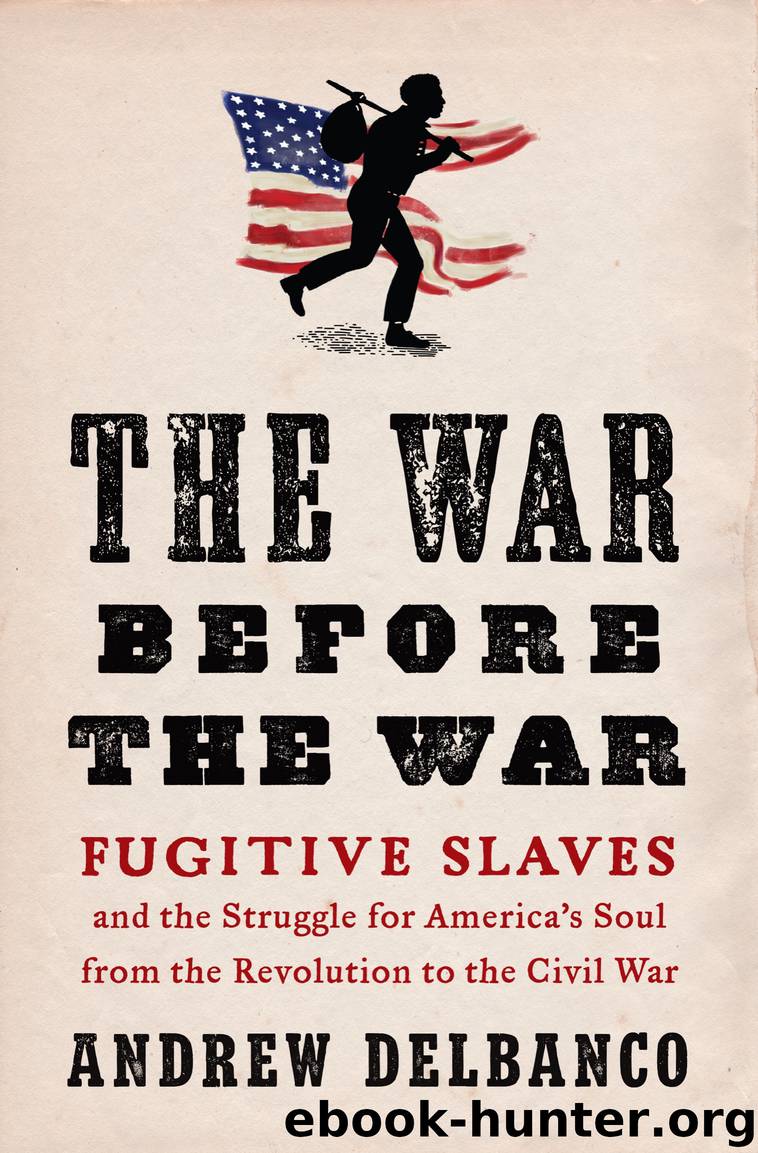
The War Before the War by Andrew Delbanco
Author:Andrew Delbanco
Language: eng
Format: epub, azw3
Publisher: Penguin Publishing Group
Published: 2018-11-05T16:00:00+00:00
On the left, William Lloyd Garrison supports a slave woman while brandishing his gun at a slave catcher, equipped with noose and shackles, mounted on the back of Daniel Webster. Behind Garrison stands an armed black man; another holds a slave owner by the hair and is about to whip him. Amid the chaos, Webster, holding the Constitution, offers a crashing understatement: “This, though Constitutional, is extremely disagreeable.”
Potter’s agents—whom Dana, again an attorney for the defense, described with withering irony as “low-bred, dissolute, degraded beings” in whose hands “no man’s property would be safe a moment”—secured a warrant from Commissioner Curtis for Sims’s arrest. “In the name of the President of the United States of America,” the document stated, “you are hereby commanded forthwith to apprehend Thomas Sims now alleged to be in your District, a colored person, charged with being a fugitive from service in the State of Georgia.”
That same night, three policemen found Sims walking on the street with several companions. When he resisted arrest, they charged him with disorderly conduct and with stealing a watch they discovered on his person. Before being subdued and taken in handcuffs to the Boston courthouse, he briefly broke loose and slashed one of the officers with a pocketknife, which Theodore Parker later called “a most unlucky knife, which knocked at a kidnapper’s bosom, but could not open the door.” In order to comply with the 1843 Massachusetts “Latimer law” forbidding use of state facilities in a fugitive slave case, Marshal Devens declared the courthouse a federal jail.
News of these events was met in antislavery circles with a mixture of horror and welcome. William Lloyd Garrison, hosting an emergency meeting of the Vigilance Committee at the offices of the Liberator, was in an I-told-you-so mood, as if this latest case only proved his long-held conviction that North and South must cut all connection. Other members, hoping to find an orderly path out of the crisis, pondered their legal options. Some were pacifists. Others urged another round of action in the streets. Lewis Hayden, as if to embarrass the dithering whites, huffed and puffed that black Bostonians would take matters into their own hands just as they had done in the Shadrach case.
In fact, the prosecutions of those who had assisted in Shadrach’s rescue had persuaded scores of black Bostonians to leave the city, and Hayden—under indictment himself—admitted privately to one committee member that he was bluffing in the hope that his white friends would not realize “how really weak we are.” Although most black people in Boston—roughly 2,000 in a city of 140,000—had more reason to worry about losing their jobs to Irish immigrants than about their personal vulnerability to the fugitive slave law, many were enraged. Even before the Shadrach rescue, Henry Weeden, a tailor active in the effort to integrate Boston’s public schools, had given his rage pointed expression upon receiving an overcoat belonging to the U.S. marshal Watson Freeman:
Download
This site does not store any files on its server. We only index and link to content provided by other sites. Please contact the content providers to delete copyright contents if any and email us, we'll remove relevant links or contents immediately.
| Anthropology | Archaeology |
| Philosophy | Politics & Government |
| Social Sciences | Sociology |
| Women's Studies |
Nudge - Improving Decisions about Health, Wealth, and Happiness by Thaler Sunstein(7712)
The Fire Next Time by James Baldwin(5452)
iGen by Jean M. Twenge(5419)
Adulting by Kelly Williams Brown(4581)
The Sports Rules Book by Human Kinetics(4395)
The Hacking of the American Mind by Robert H. Lustig(4386)
The Ethical Slut by Janet W. Hardy(4261)
Captivate by Vanessa Van Edwards(3842)
Mummy Knew by Lisa James(3694)
In a Sunburned Country by Bill Bryson(3546)
The Worm at the Core by Sheldon Solomon(3489)
Ants Among Elephants by Sujatha Gidla(3468)
The 48 laws of power by Robert Greene & Joost Elffers(3294)
Suicide: A Study in Sociology by Emile Durkheim(3024)
The Slow Fix: Solve Problems, Work Smarter, and Live Better In a World Addicted to Speed by Carl Honore(3013)
The Tipping Point by Malcolm Gladwell(2929)
Humans of New York by Brandon Stanton(2875)
Get What's Yours for Medicare: Maximize Your Coverage, Minimize Your Costs by Philip Moeller(2758)
Handbook of Forensic Sociology and Psychology by Stephen J. Morewitz & Mark L. Goldstein(2707)
